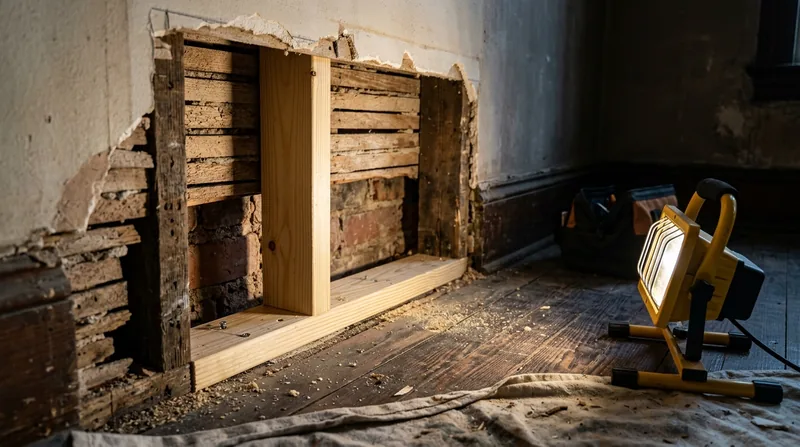




Richmond's dense Victorian rowhouses, Federal townhouses, and Craftsman bungalows rest on foundations built a century or more ago, when termites were an accepted cost of wood-frame living in the humid subtropical climate. When an exterminator confirms an infestation and leaves, the structural damage remains: softened studs, honeycombed sill plates, weakened floor joists, and compromised subfloor sections that won't regain strength on their own. Termite damage repair in Richmond means replacing that eaten wood with solid dimensional lumber, restoring full structural integrity to your home. We work from your pest inspection report, replacing termite-damaged framing, sills, trim, and subfloor in the Fan District, Church Hill, Jackson Ward, and throughout the greater Richmond area. Unlike pest control, which is a separate licensed trade, we do the carpentry: remove the damaged wood, install new studs and joists, and leave your frame as sound as it was built.
Why Termite Damage Repair Matters in Richmond's Older Housing Stock
Richmond's building stock is old, wood-heavy, and vulnerable. The rowhouses lining the narrow streets of the Fan, the brick townhouses on Church Hill's cobblestone hills, and the Craftsman bungalows in the Museum District all rest on heart-pine sill plates, Douglas fir rim joists, and floor framing that termites find irresistible. Termite colonies work slowly but relentlessly, eating from the inside out, often undetected for months or years. By the time a pest inspection reveals the problem, structural members may be seriously compromised. Delaying repair allows damage to spread upward through rim joists into wall studs, sideways through band board into adjacent sections, and downward into subfloor. Early repair stops the spread and avoids far costlier framing work later.
- We identify which members can be repaired by sistering new lumber alongside sound wood, and which must be fully replaced.
- We source lumber species and dimensions matching the original frame, so repairs integrate structurally and aesthetically.
- We document the work for your insurance claim and ensure repairs meet Richmond building code standards.
- We work around your schedule and minimize disruption to occupied homes, a common need in dense urban neighborhoods.
Addressing termite damage promptly prevents structural decay from accelerating and keeps repair costs proportional to the actual scope of the problem.
Key info: Virginia's humid subtropical climate, with hot muggy summers and occasional ice storms, creates ideal conditions for termite activity. Infestations in Richmond commonly target sill plates and rim joists in crawlspaces and basements, where moisture is highest. Early detection through annual pest inspections and prompt repair of any damage keeps repair costs manageable.
For more information on related structural wood damage, see our page on wood rot and dry rot repair in Richmond, which covers similar framing failures from moisture and decay.
How Termite Damage Repair Works: Our Process in Richmond
We start with your pest inspection report and a site visit to assess which wood members are damaged and how badly. Sound wood can often be saved by sistering new lumber alongside it, bolting the two together to share the load. Heavily damaged wood must be removed and replaced. In crawlspaces and basements, we work methodically to avoid disturbing your home, remove damaged joists and sill sections, install new members at proper spacing, and verify plumb and level before closing up. For damage in walls or upper floors, the work is more involved but follows the same principle: remove the compromised member, install a new one cut to exact length, and restore full load transfer through the frame.
- We photograph the damage, document the extent in writing, and provide this documentation to your insurance company.
- We obtain any required permits from the Richmond Department of Planning and Development, especially if the repair affects load-bearing members.
- We source replacement lumber in the same species and dimension as the original, so the repair is structurally sound and visually consistent.
- We install new wood using bolts, lag screws, or traditional joinery appropriate to the member and the frame, ensuring code compliance.
- We inspect the completed work for plumb, level, and proper fastening before we leave the job.
The goal is to restore full structural integrity while respecting the age and character of your home.
Local example: A Victorian rowhouse in the Fan District with termite damage to the sill plate under a bay window required removal of a 12-foot section of sill and installation of new pressure-treated lumber, bolted to the existing rim joist and foundation wall. The work took two days, required a permit from the city, and cost in the mid-range of our estimates. The bay window remained plumb and the floor stayed level throughout.
For complex framing issues or large-scale damage, we often recommend consulting our page on floor joist and subfloor repair, which covers similar structural carpentry in detail.
Methods and Approaches to Termite Damage Repair
| Approach | Description | Best for |
|---|---|---|
| Sistering | New lumber bolted alongside existing damaged member to share structural load and restore strength. | Partial damage where the outer portion of the wood is sound and can accept fasteners. |
| Full Replacement | Damaged member completely removed and new lumber installed at identical location and dimension. | Severe damage where the wood is too soft or compromised to accept fasteners or share a load. |
| Pressure-Treated Lumber | Chemically treated wood resistant to insect and fungal decay, installed in crawlspaces and high-moisture areas. | Sill plates, rim joists, and subfloor members in basements and crawlspaces where moisture is persistent. |
| Untreated Dimensional Lumber | Standard framing lumber installed in interior walls and upper-floor framing where moisture and insect risk are lower. | Wall studs, floor joists, and trim in dry interior spaces where the original wood was untreated. |
| Blocking and Bridging | Additional cross-bracing installed between joists or studs to prevent lateral movement and distribute loads evenly. | Repairs affecting multiple joists or where structural stiffness must be restored across a span. |
Termite Damage Repair Cost in Richmond: What to Expect
Termite damage repair costs in Richmond start at around $1,200 for a small, localized repair such as a damaged section of sill plate or a few feet of rim joist in a crawlspace. The cost rises with the extent of damage, the number of members affected, the difficulty of access, and whether the work requires a permit. A repair affecting multiple joists, an entire rim joist section, or damage in a finished basement costs more because it involves more labor, more lumber, and often more careful work to avoid disrupting occupied spaces. Getting estimates from two or three carpenters is smart: it gives you a realistic range and helps you understand what drives the cost in your specific situation. See our full pricing page for detailed cost guidance and factors that affect the final bill.
Factors that commonly move the cost higher include damage in multiple locations, members that must be fully replaced rather than sistered, access challenges in tight crawlspaces or finished areas, and permit requirements for structural work. Insurance may cover part or all of the repair cost if your policy includes termite damage, though this varies widely. We can help you document the damage and prepare materials for a claim, but we cannot guarantee approval or coverage. Delaying repair typically makes the problem worse: termite colonies continue eating, damage spreads, and the final repair cost grows. Addressing it promptly keeps the scope and cost proportional to the actual damage.
Termite Damage Repair Near Me: What Richmond Homeowners Should Know When Hiring a Carpenter
Hiring the right carpenter for termite damage repair means choosing someone who understands framing, knows the code, and can explain what needs to happen and why. Look for a contractor who is fully insured and carries workers compensation coverage, so you are protected if someone is injured on your property. Ask for references from recent customers, especially those who had similar structural work done, and follow up with a call or visit if you can. Get written estimates from at least two contractors, and make sure each estimate explains what is included, what wood will be replaced versus sistered, and whether a permit is required. If your home is in a historic district such as the Fan, Jackson Ward, or Church Hill, check with the Richmond Planning Department about any design review requirements that might affect the repair. If you live in an HOA community in Short Pump, Bon Air, or Glen Allen, verify any architectural approval requirements before work begins.
The cheapest estimate is not always the best value. A carpenter who takes time to assess the damage carefully, explains the repair in detail, and commits to code-compliant work will deliver a repair that lasts. We are happy to answer your questions and provide a free estimate. Call us at (804) 593-0473 or visit our contact page to request an estimate. We respond within 24 hours and there is no obligation to book.
Termite Damage Repair in Richmond: Pricing Guide
| Service | Price | Details |
|---|---|---|
| Small localized repair | Starting at $1,200 | Damaged sill section or short rim joist in crawlspace, sistered or replaced, includes labor and lumber |
| Medium repair, multiple members | Starting at $3,500 | Multiple joists or sill sections affected, or damage in accessible basement, includes full documentation for insurance |
| Large or complex repair | On estimate | Damage in finished areas, multiple structural members, or work requiring permit and careful sequencing, site visit required |
| Travel | Included | Richmond, Henrico, Chesterfield, and surrounding areas, no separate mileage or call-out fee charged |
| Free estimate | No charge | Response within 24 hours, includes site assessment and written cost range, no obligation to book |
Indicative pricing, the exact cost depends on square footage, finish, and site access. Free personalized estimate within 24h at (804) 593-0473.


